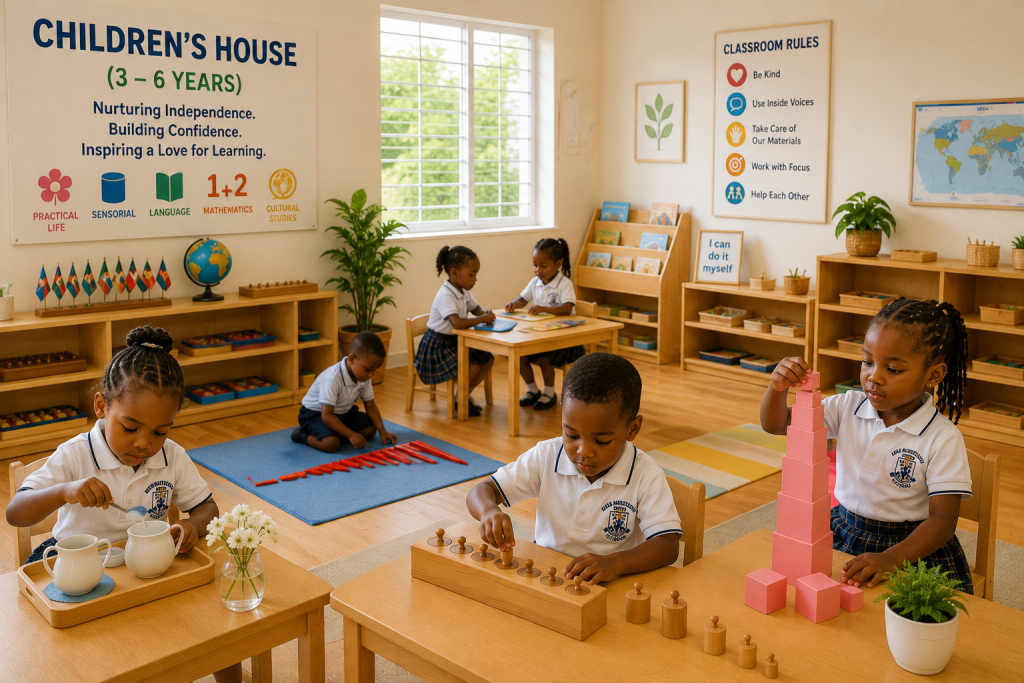
Pre-School
Creche & Nursery 1–2 (Ages 1–4 Years)
The early years are a foundational period of rapid growth and discovery. At Dela Montessori School, children learn through purposeful play, sensory exploration, movement, stories, music, creative activities, practical experiences, and interaction with their environment.
Our programme focuses on building strong foundations in language, early mathematical thinking, independence, creativity, physical coordination, social development, and awareness of the world.
Learning Areas
Language and Literacy
Children develop listening, speaking, vocabulary, and early literacy skills through songs, rhymes, stories, picture books, conversations, phonics, and language activities.
Numeracy
Children explore numbers, quantities, shapes, patterns, sorting, matching, sequencing, and measurement through hands-on Montessori activities, games, puzzles, and everyday experiences.
Practical Life & Sensory Exploration
Children participate in age-appropriate Practical Life activities such as pouring, transferring, cleaning, dressing, arranging, and caring for their surroundings. These experiences develop coordination, concentration, independence, and confidence.
Sensory exploration allows children to discover the world through touch, sight, sound, smell, movement, and direct manipulation of materials.
Our World and Our People
Children learn about themselves, their families, school, community, Ghanaian culture, animals, plants, nature, food, occupations, and their environment. Activities also encourage kindness, respect, cooperation, and responsibility.
Creative Arts
Through drawing, painting, colouring, modelling, music, singing, movement, drama, and crafts, children develop imagination, creativity, fine-motor coordination, confidence, and self-expression.
Psychomotricity (0–3 Years)
Between birth and three years, children are natural sensorial explorers, discovering the world through their five senses. Physical independence develops rapidly during this stage—babies move from crawling to standing and walking, while hand movements gradually gain coordination and control.
At Dela Montessori School, we provide specific materials and activities to support both gross motor skills (whole-body movements) and fine motor skills (hand and finger coordination). Sensorial experiences also help children explore colors, shapes, smells, tastes, textures, and sounds, allowing them to understand and engage with their environment.
Practical Life Includes:
Caring for self
Caring for the environment
Food preparation
Arranging furniture
Grace and courtesy
Kindergaten — KG 1–2
Ages 4 - 6 Years
The Kindergarten years are a time of rapid development, exploration, and discovery. Our KG programme combines Montessori principles with the Ghana Education Service curriculum to provide children with meaningful opportunities to learn through purposeful play, hands-on experiences, movement, exploration, and interaction.
Children are encouraged to ask questions, communicate their ideas, make choices, develop independence, and build positive relationships.
Learning Areas

Language and Literacy
Children develop listening, speaking, vocabulary, phonics, early reading, and writing skills through stories, songs, rhymes, picture books, conversations, and language games.

Numeracy
Children develop foundational mathematical understanding through counting, quantities, patterns, shapes, sorting, classification, measurement, and simple operations. Montessori materials help children move from concrete experiences toward early abstract thinking.

Our World and Our People
Children explore family, community, culture, Ghanaian traditions, nature, animals, occupations, safety, health, relationships, and the environment. These experiences develop curiosity, respect, responsibility, and social awareness. Creative Arts Children explore drawing, painting, colouring, cutting, modelling, music, singing, movement, drama, and crafts. Creative activities develop imagination, coordination, concentration, confidence, and self-expression.

French
Children are introduced to French through songs, rhymes, stories, games, movement, conversations, and everyday classroom activities, building early listening and speaking skills and an appreciation of other languages and cultures.

Play and Exploration
Purposeful play remains central to learning at this stage. Children have opportunities to choose, explore, practise, create, collaborate, and discover, while teachers provide guidance and encouragement according to each child's developmental needs.

Creative Arts
Children explore drawing, painting, colouring, cutting, modelling, music, singing, movement, drama, and crafts. Creative activities develop imagination, coordination, concentration, confidence, and self-expression.
